


Don't let the "data" fool you
- Ally Bolender

- Mar 6, 2019
- 2 min read
When news organizations cite data from another source, you may often find they only include the data that benefits their argument. It's important to check the data source and read the hard facts. I personally love data because it's numbers -- and numbers (usually) don't lie. I believe conclusions can be accurately drawn from reputable and reliable research sources, otherwise, the data may be be laced with picked out samples, intended outliers, and statistical bias.
I'm going to share an example of data used in media where the journalist clearly slept through their statistics class.


This VOX article dives into free speech among professors, explicitly saying "Data shows a surprising campus free speech problem" and "left-wingers being fired for their opinions." Believable, right? Wait until you read the article AND data.

There were 16 liberal professors fired and 6 conservative professors fired due to political speech, resulting in a 3:1 ratio.
But you need to dive into the data to understand what it's actually telling you, VOX. Don't just read the first paragraph.
According to Econ Watch Journal, there are 3,623 registered democratic professors and 314 registered republican professors. With this information, we know liberal professors outnumber conservatives at a ratio of 12:1.
That means, proportionally, conservative professors are being fired 4x as much as liberal professors for political speech.
So, why did VOX say "Left-wingers being fired for their opinions" when obviously both sides get fired for political speech? With data showing conservatives being fired more?
We can't forget the best part of this contradicting article: "Data shows a surprising campus free speech problem..."
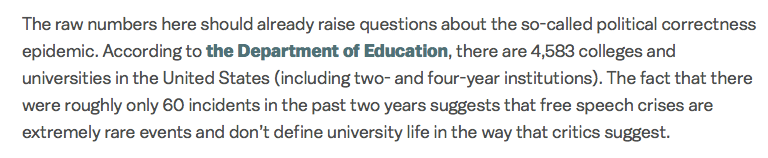
"The fact that there were roughly only 60 incidents in the past two years suggest that free speech crises are extremely rare events that don't define university life in the way that critics suggest."
So why would you explicitly say there is a problem in the title, and completely contradict that in the article, VOX?
I hope this encourages you that just because an article says "data" does not necessarily mean the journalist actually interpreted the data correctly. Also, another example of why you should never take headlines too seriously.



Comments