Professional Portfolio
Mourning with Masks
COVID-19 (Coronavirus) has changed the way the San Marcos community grieves.
By Ally Bolender
Nov. 30, 2020

San Marcos City Cemetery caretaker Jay Cody standing outside his office. Shortly after he took the position in 2019, he began decorating the entrance of his office with discarded flowers. Photo by Ally Bolender
“People were throwing (the flowers) away, so I thought rather than throwing them away, I'm just going to go ahead and do something with them," said Cody. "So I made it look better and brighter for people when they come.”
SAN MARCOS, Texas—Jay Cody took the position of cemetery caretaker at the San Marcos City Cemetery in December 2019, one month before the first Coronavirus case entered the United States.
“I didn’t know what to expect, and nobody did really,” said Cody. “I got to reading and thought, ‘Oh gosh, it’s going to be busy. There’s going to be deaths—and we’re going to have to deal with it.’”
Cody, 62, is responsible for taking care of people in need of services related to the cemetery, such as purchasing plots or burying loved ones. Cody assists with funeral services at the cemetery as well.
Cody believes that the Coronavirus pandemic has shaped the way people plan and think about death. Cody has seen increases in younger people purchasing plots, cremations with postponed services and smaller, socially-distanced outdoor services at the cemetery.
“I think (death) is on the forefront of a lot of people’s mind now,” said Cody. I think it’s just kind of a forced issue of, ‘Hey, we have never thought of this, so maybe we ought to think of this.... and it’s not just old people. There’s young people. There’s 30-year-olds coming in and buying plots. It’s an interesting twist.”
Cody says he has been extremely busy selling plots to San Marcos locals in the last few months. He suspects that this rise in plot purchases can be attributed to Coronavirus.
In 2019, 79 plots were purchased over the course of 12 months. As of Oct. 23, 2020, 93 plots have been sold, according to the City of San Marcos.
But the biggest increase in his work has yet to come.
“I figured we’d have an increase in activity, but what we’ve seen more than anything is people cremating and they’re going to wait to have a service,” said Cody. “I think at some point we will get very, very busy with these cremates that will need to be buried.”
A Musician with no Music
Tim Bauerkemper, 45, is a pastor at the First Lutheran Church in San Marcos. The valuable role he plays in supporting his community members has been nearly impossible given the pandemic.
Bauerkemper says the Coronavirus has made it especially hard to be present with people dealing with death.
As a pastor, Bauerkemper’s job is to be there with his church members during their final hours. He holds hands and prays over those who are dying so that they may peacefully pass.
“It’s really been a challenge because, as a pastor, I can’t do the things I normally would—bring comfort as people die, and even then, for the family after someone has died,” said Bauerkemper.
The former organist at Bauerkemper’s church, Byron Wolverton, died at the age of 86 on September 7 from a short illness.
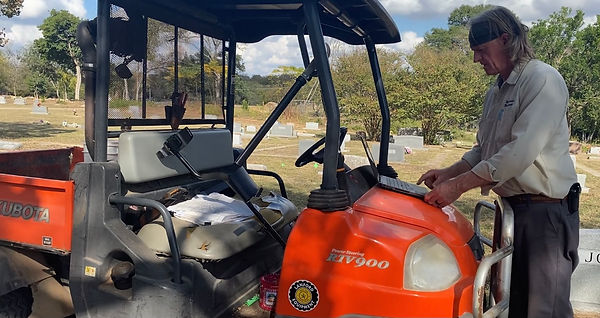
Cody has developed a new system for marking, updating and registering plots for families due to the increase of interest because of the pandemic. For the first time, Cody has implemented technology into the process. He brings his computer along with him while marking plots. Photo by Ally Bolender
"My number one priority, my first job, is to take care of families, individual(s), whomever needs the service..." said Cody.

Wolverton was a musician his entire life. He held a faculty position in the Music Department at Southwest Texas State University for over 30 years, retiring in 1997.
Wolverton was described as a talented, patient and well-regarded teacher who impacted the lives of hundreds of music students.
The service for the musician was held outside at the San Marcos city cemetery. A small selection of family members crowded around his graveside.
Bauerkemper read the eulogy at the service for his former congregation member.
Wolverton’s funeral service was held outside by the graveside. It was quiet and small, with only close family members and his church’s pastor surrounding the space. Photo by Ally Bolender
Hugs are encouraged to be replaced with loving glances from above the nose. The required masks soak up grieving tears. Funeral services are now required to be spaced out, even between the deceased and those viewing.
Tracy Fuller, 50, died from cancer on September 2020. The pandemic prevented a full ceremonial celebration of Fuller’s life.
Lori Bramlett, 51, was Fuller’s sorority sister and close friend of over 30 years. Bramlett attended the service held for Fuller on September 19 at the WoodsEdge Community Church in Spring, Texas.
“I know it was as normal as it could possibly be,” said Bramlett. “We all had to wear masks...when we got into the sanctuary, we had to be seated every other row.”
Bramlett explained that the required mask mandate made the funeral service less intimate.
“When I was trying to find people...I couldn’t recognize anyone,” said Bramlett. “I couldn’t see faces.”
Hugging, an important sign of condolence at funeral services, is now more dangerous since the pandemic.
“I hugged a few people I was close with,” said Bramlett.
The Fuller family held an indoor service at their community church for the late mother of three school-aged children, but other families sometimes opt for outdoor services where it may be safer for older family members to attend.

More than half of funeral directors have experienced increased cremation rates due to the coronavirus pandemic, according to the 2020 Cremation and Burial Report, released by the National Funeral Directors Association (NFDA).
Funeral services look much different now. Texas funeral homes are expected to follow specific pandemic guidelines mandated by the Texas Funeral Service Commission (TFSC).


Information retrieved from the Texas Funeral Service Commission COVID-19 guidelines. Graphic by Ally Bolender

Cody marking a plot for a cremation that will be buried in the coming weeks. He says that preparing for cremation burials and inquiries about cremation burials has been the busiest of his work in the last few months. Photo by Ally Bolender

Plot purchases each month from 2017-2020, January-September. Information received from the City of San Marcos.
Graphic by Ally Bolender

Yearly plot purchases from 2017-2020. The 2017, 2018 and 2019 plots purchases include numbers from January to December. The 2020 plot purchases are from January to September. Information received from the City of San Marcos.
Graphic by Ally Bolender
2017
2018
2019
2020
“Having scaled down what we were able to do meant that it wasn’t the funeral that the family would have wanted,” said Bauerkemper.
Contrasting from the life that the devoted-musician lived, the service was quiet and small.
“There wasn’t any music at the graveside,” said Bauerkemper. “And that was hard for his family. Music had been a part of their lives because it was his life.”
Jay Cody and The San Marcos City Cemetery
Looking Ahead
Hays County epidemiologist Eric Schneider urges residents to follow Coronavirus precautions as the flu and holiday season arrives.
"Family is so important, yet we need to consider how we interact with others this holiday season," said Schneider. "We each need to take actions to protect the elderly and at-risk community."
As of November 23, the Hays County Local Health Department has reported 99 Coronavirus-related deaths. About 96% of the fatalities were residents over the age of 50.
The 2020 winter season will be Cody's first winter as the sole cemetery caretaker. He is not sure how the unprecedented pandemic will affect his work, but he says that he has been preparing to take on more work as the winter season approaches.
"The winter months is when you get a lot of flu deaths and elderly folks and that is what I was told. You’ll see a lot in December, February, January, and I haven’t seen that so much last year....I’ll know more this winter," said Cody.